Hebrews · Chapter 6
Hebrews 6 KJV Explained Verse by Verse
Also on

About Hebrews 6
Some of the storms in your life don’t announce themselves. A phone call comes in the middle of a normal day, and by the time you hang up, nothing feels steady anymore. Chapter 5 left these believers still living on milk when they should have grown up by now. Chapter 6 calls them to grow up, and it hands them an anchor for every storm.
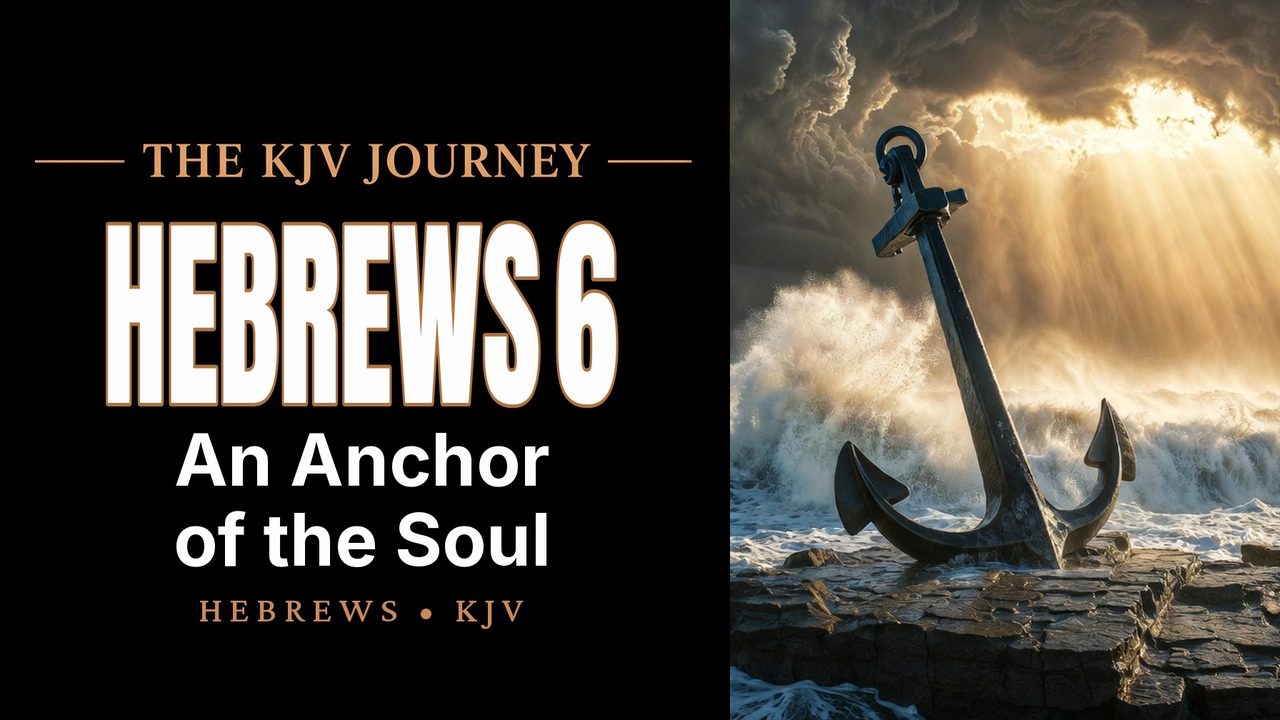
Verse 19: “Which hope we have as an anchor of the soul, both sure and stedfast, and which entereth into that within the veil;”
Hold on to that word, anchor. An anchor doesn’t stop the storm. It keeps the boat from drifting while the storm goes on. And this anchor doesn’t hook into sand on the bottom of the sea. It reaches past the veil, into the very presence of God, where Jesus has already gone ahead of us. But before the chapter gets there, it passes through a warning that has frightened a lot of people.
So who are the people in verses 4 through 6, who tasted the heavenly gift and then fell away?
Teaching Notes
Go on to maturity (verses 1–3)
Verse 1 says “let us go on unto perfection.” Perfection here means maturity, being grown up in the faith. Leaving the basic teaching about Christ doesn’t mean throwing those truths away. It means building on them instead of starting over. The foundation is listed for us: turning away from dead works, faith toward God, teaching about baptisms, the laying on of hands, the resurrection of the dead and eternal judgment. Those are first lessons, and they matter, but nobody lives in a foundation. Baptism is in that list. It follows faith, and it does not save anyone. And verse 3 says we will go on “if God permit.” Even our growing up depends on God allowing it.
Tasted, but never taken in (verses 4–8)
Verses 4 through 6 describe people who were once enlightened, who tasted the heavenly gift, shared in the Holy Ghost, and tasted the good word of God and the powers of the world to come. Those powers may point to the signs and wonders of chapter 2, verse 4. If they fall away, verse 6 says it is impossible to renew them again to repentance. And the word tasted shows up twice in those verses. To taste something isn’t the same as to take it in and live on it. Here’s what I believe the passage is describing: people brought very close to the truth who, with all of that in front of them, turned their backs on Christ. It does not teach that a true believer can lose his salvation. Then comes the picture (verses 7–8): two fields get the same rain. One drinks it in and bears a crop and receives blessing from God. The other bears thorns and briers.
Better things (verses 9–12)
Right after that hard warning, these readers are called beloved, and better things are expected of them (verse 9). The warning was a wake-up call, not a door shut in their faces. God is not unrighteous to forget their work and labor of love (verse 10). They are to keep that diligence to the end (verse 11), following those who through faith and patience inherit the promises (verse 12). Faith trusts that God will keep His word. Patience keeps trusting while you wait for Him to do it.
Two things that cannot change (verses 13–18)
Abraham is the example. When God made His promise to Abraham, there was no one greater to swear by, so He swore by Himself (verse 13). That oath comes from Genesis 22, right after Abraham was willing to offer up Isaac. Abraham patiently endured and obtained the promise (verse 15). Genesis 12 says he was 75 when he left Haran, and Genesis 21 says he was 100 when Isaac was born: twenty-five years of waiting on a promise. To show the heirs of promise that His plan would never change, God confirmed it by an oath (verses 16–17). That gives us two things that can never change, His promise and His oath, and in both of them it is impossible for God to lie (verse 18).
An anchor within the veil (verses 19–20)
Stedfast means firm and steady. This anchor reaches past the veil, the curtain in front of the most holy place, into the very presence of God. Jesus has already gone in there ahead of us as the forerunner, a high priest for ever after the order of Melchisedec (verse 20). With that, the writer is back to the subject he called hard to explain in chapter 5.
Hebrews 6 (KJV)
1 Therefore leaving the principles of the doctrine of Christ, let us go on unto perfection; not laying again the foundation of repentance from dead works, and of faith toward God,
2 Of the doctrine of baptisms, and of laying on of hands, and of resurrection of the dead, and of eternal judgment.
3 And this will we do, if God permit.
4 For it is impossible for those who were once enlightened, and have tasted of the heavenly gift, and were made partakers of the Holy Ghost,
5 And have tasted the good word of God, and the powers of the world to come,
6 If they shall fall away, to renew them again unto repentance; seeing they crucify to themselves the Son of God afresh, and put him to an open shame.
7 For the earth which drinketh in the rain that cometh oft upon it, and bringeth forth herbs meet for them by whom it is dressed, receiveth blessing from God:
8 But that which beareth thorns and briers is rejected, and is nigh unto cursing; whose end is to be burned.
9 But, beloved, we are persuaded better things of you, and things that accompany salvation, though we thus speak.
10 For God is not unrighteous to forget your work and labour of love, which ye have shewed toward his name, in that ye have ministered to the saints, and do minister.
11 And we desire that every one of you do shew the same diligence to the full assurance of hope unto the end:
12 That ye be not slothful, but followers of them who through faith and patience inherit the promises.
13 For when God made promise to Abraham, because he could swear by no greater, he sware by himself,
14 Saying, Surely blessing I will bless thee, and multiplying I will multiply thee.
15 And so, after he had patiently endured, he obtained the promise.
16 For men verily swear by the greater: and an oath for confirmation is to them an end of all strife.
17 Wherein God, willing more abundantly to shew unto the heirs of promise the immutability of his counsel, confirmed it by an oath:
18 That by two immutable things, in which it was impossible for God to lie, we might have a strong consolation, who have fled for refuge to lay hold upon the hope set before us:
19 Which hope we have as an anchor of the soul, both sure and stedfast, and which entereth into that within the veil;
20 Whither the forerunner is for us entered, even Jesus, made an high priest for ever after the order of Melchisedec.